



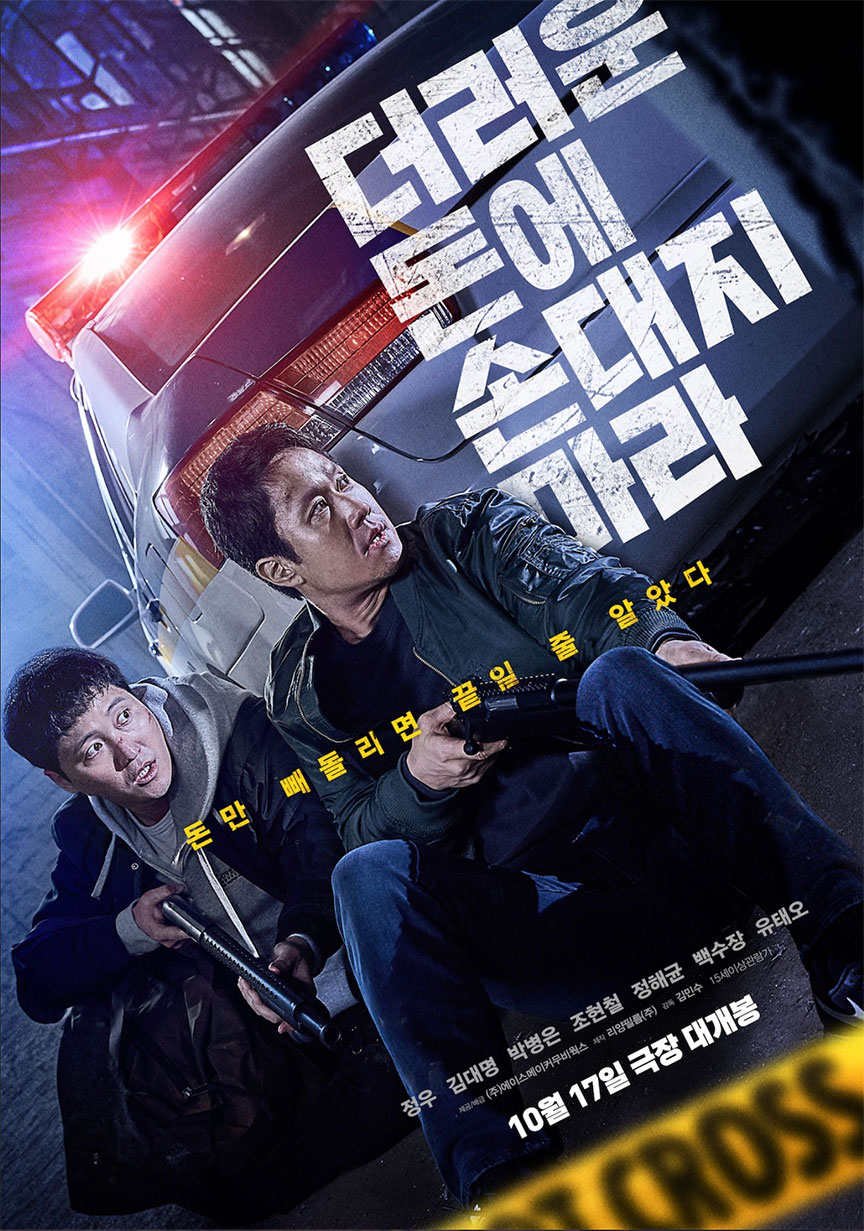
“Dirty Money” Poster
Director: Kim Min-Soo
Cast: Jung Woo, Kim Dae-Myung, Park Byung-Eun, Cho Hyun-Chul, Jung Hae-Kyun, Baek Soo-Jang, Yoo Teo, Lim Hwa-Young, Kim Yoon-Sung
Running Time: 100 min.
By Paul Bramhall
Is there anything more dangerous in cinema than the trope of a character hauling around a bag of cash that doesn’t belong to them? Almost every country has an entry, and Korea is no different, with 2020’s Beasts Clawing at Straws being a classic example. In 2024 it got some company with Dirty Money, the directorial debut of Kim Min-soo. An established scriptwriter (he’s expectedly also behind the script here), Min-soo co-wrote the likes of 2017’s The Merciless and 2022’s Kingmaker with Byun Sung-hyun, who’d direct both, so it would seem he’s keen to follow in Sung-hyun’s footsteps and similarly direct from his own scripts.
The plot of Dirty Money concerns a pair of corrupt cops played by Jung Woo (Hot Blooded, Spare) and Kim Dae-myung (Drug King, Inside Men), who’ve been leveraging their positions to extort the petty criminals they’re associated with and keep their pockets lined. For Woo he uses the ill gained funds to save up for an operation his sick daughter desperately requires, an unfortunate genetic disease passed on from his late wife, while Dae-myung uses his share to feed a gambling addiction. In the opening the pair are called to attend an apparent suicide, however upon investigating the scene there are several signs that point to it being a murder. Shortly after their arrival though a colleague from the Serious Crimes unit shows up and kicks them out, announcing they’re taking over the case, but not before Woo discovers an SD card hidden under a plaster the victim was wearing, which he pockets for further investigation.
It turns out Woo and the colleague from Serious Crimes, played by Teo Yoo (Past Lives, Seoul Searching), are acquainted, with Woo having previously been a part of the team before he was kicked off for taking bribes. Still sharing a slither of trust, Yoo reveals the victim was an informant working with the Chinese gangs, responsible for collecting intel on a large sum of money that was due to be shipped to China. The informant had let them know he’d managed to get the details of the transaction, however was killed before it could be shared. Realising that the intel is most likely stored on the SD card he found, which reveals it to be a serious amount of money, Woo and Dae-myung make a plan to steal it from the Chinese before it ships. A few balaclavas, shotguns borrowed from the storeroom, and a getaway car later, the pair are all set to raid the Chinese hideout and take off with the stash. What could possibly go wrong?
As it happens, Dity Money fits squarely into the ‘everything that can go wrong will go wrong’ heist genre, which should also answer the question. Descending into a bullet riddled bloodbath, the pair escape with the cash, but their plan to get in and out before anyone can even register what’s going on is a complete disaster, leaving a trail of bodies in their wake. With both the cops and the Chinese gangsters looking to get to the bottom of what went down, Woo and Dae-myung stash the cash in an isolated barn, and do their best to assist in the investigation (leading to them humorously working on their own crime) while they wait for things to cool down.
While the concept of Dirty Money is far from original, when stories like this are executed well, the level of tension they can crank up easily mitigates any sense of familiarity the story may suffer from. Despite being a first-time director, Min-soo seems to know this, and does a stellar job of making it feel like the walls are gradually closing in on the pair. What works particularly well is the way narrative frames the pressure from multiple angles. There’s the gradually fracturing relationship between Woo and Dae-myung, as the trust that neither of them will touch the hidden stash begins to falter, the cops own investigation, and their attempts to steer it away from what went down, and the gangsters ruthlessly violent approach to seeking answers at any cost.
When it comes to the latter, anyone who’s been watching Korean cinema for a while will know when a crime flick contains a Chinese gang (see the likes of New World and The Outlaws for classic examples!), it’s not going to be good news for whoever crosses them, and that’s never truer than here. Min-soo’s script is particularly entertaining in that it makes the Chinese crime boss, played with boisterous relish by Baek Soo-jang (Rampant, Miss Baek), a character who’s inherently smart. Once one of his lackeys reveals Dae-myung spent an unusually long time talking to the manager of the casino they run during one of his visits, he soon cottons on to what possibly went down, and when you wake to find yourself tied to a chair in a shipping container in a movie like this, it’s never good news.
I’ve put the argument forward before that, since Korean cinema attendance is currently in the doldrums, with bigger budgets no longer as accessible as they once were, we’re seeing a return to more mid-budget productions that focus on story and character over spectacle. So while the explosion of popularity towards Korean culture has seen the big dollars ploughed into streaming content that feels like it’s increasingly made to appeal to international audiences (a trait also reflected in K-pop, which is now mostly sung in English), in cinema we’re seeing a return to more local flavoured productions. The change in direction may be one that’s driven by necessity as much as it is through choice, but personally I feel if the result is more movies like My Daughter Is a Zombie and Dirty Money, then it’s a positive. Of course the key ingredient is for Korean audiences to agree, as it’s ultimately them that the cinemas rely on to come back.
I also say that since it feels characteristic of Korean cinema, especially during the Korean Wave period of the 2000’s, to not be afraid of having a cast consist of morally reprehensible or difficult to like characters. The characters of Woo and Dae-myung feel like their distant relatives of the like of Sol Kyung-gu in 2002’s Public Enemy, or Jung Woo-sung in 2017’s Asura: City of Madness, in that they’re essentially good people who’ve gotten into the habit of doing very bad things. Relatable villains could be the best way to describe them, with the audience’s connection to them based on generating empathy from the fact they have a number of not so relatable villains on their tail. Dirty Money executes this concept to the extreme, as it entertainingly reveals almost every character to be a villain of some sort, sometimes in a way which both exasperates and feels admirable at the same time for the way it can sucker punch the viewer.
Without doubt though the biggest strength of Dirty Money is its pacing, with Min-soo establishing an ever-escalating series of mishaps that unfold over the tight 100-minute runtime, ensuring the question of if Woo and Dae-myung are going to make it to the end never feels like it has an obvious answer. I often found myself thinking that it’s the type of movie Johnnie To and Milky Way Image would make in Hong Kong if there weren’t so many censorship laws to worry about, with its lean crime thriller trappings and sudden bursts of violence echoing the DNA of To’s late 90’s/early 00’s classics.
While the ending may polarize in the fate of the characters, in many ways it also provides a fitting conclusion to a consistently fraught and tension filled journey through the underbelly of Korea, one which remains engaging through to the end credits. I confess if Dirty Money had come out 15 years ago I’d probably be writing it’s another serviceable thriller from Korea’s overcrowded genre pool that does the job it sets out to. However there’s something to be said for the expression “they don’t make them like they used to”, and with Dirty Money Min-soo has proven that even if you put old wine into a new bottle, the ingredients still work.
Paul Bramhall’s Rating: 7.5/10