


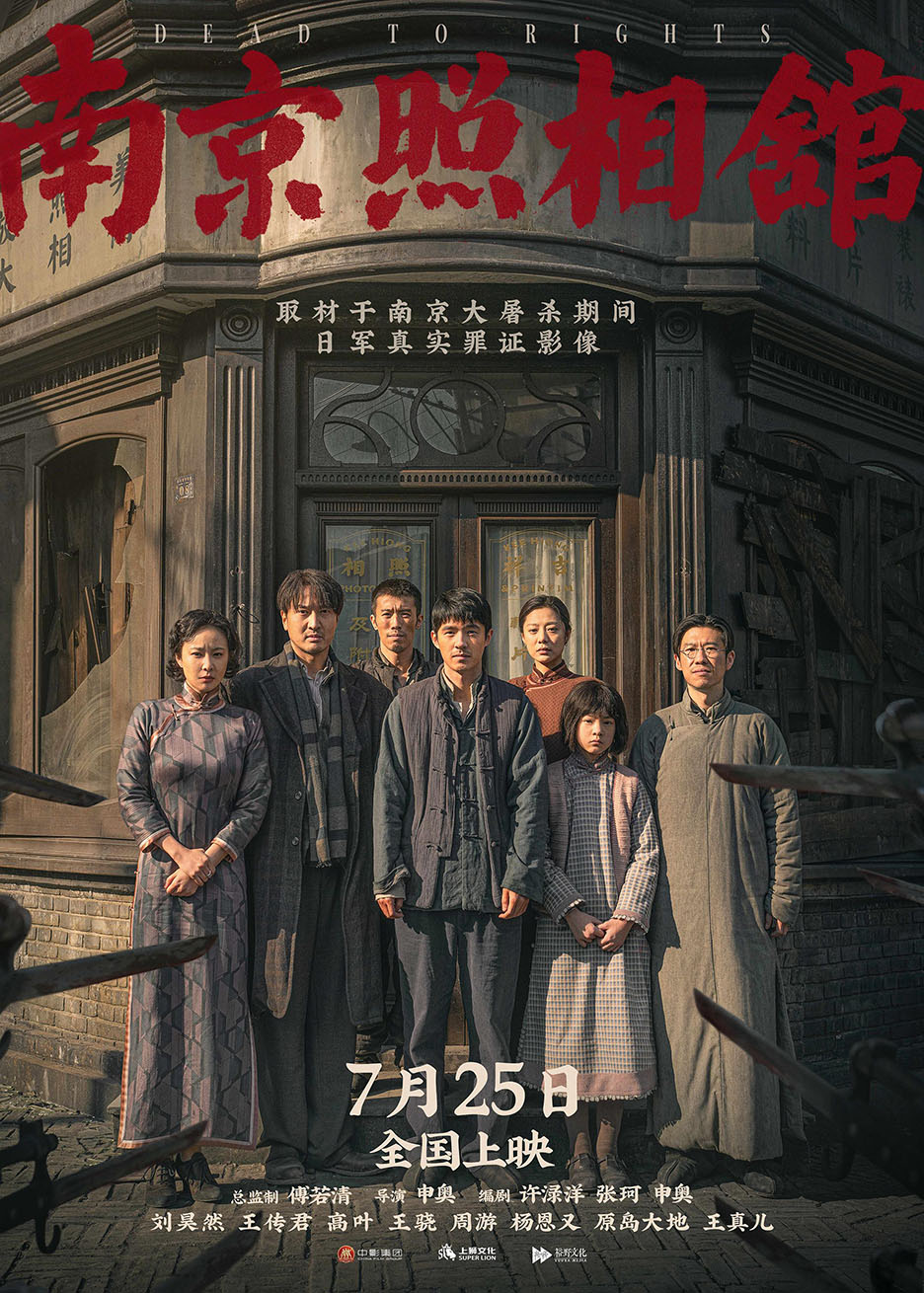
“Dead to Rights” Poster
Director: Shen Ao
Cast: Liu Haoran, Wang Chuanjun, Gao Ye, Wang Xiao, Zhou You, Yang Enyou, Daichi Harashima
Running Time: 137 min.
By Paul Bramhall
The Nanjing Massacre remains one of the most harrowing examples of wartime atrocities in recent history, with the Japanese army systematically murdering and raping an untold number of Chinese, regardless of if they were military, men, women, or children in December 1937, lasting well into 1938. Several filmmakers have adapted it for the screen over the years, from T.F. Mou’s Black Sun: The Nanking Massacre to more recent works like Zhang Yimou’s The Flowers of War, and in 2025 China’s Oscar submission for Best International Feature also tackles the same period in Dead to Rights.
The story is inspired by a photo studio apprentice, Luo Jin, who worked in Nanjing at the time, and was ordered by a Japanese officer to develop two rolls of film. The shots, taken by Japanese soldiers to commemorate their massacre of the Chinese, were so shocking that he printed an extra set and hid them in a handmade album, which later became irrefutable evidence of the atrocities. Director Shen Ao (No More Bets, My Dear Liar) uses this historical context to craft a story of a young postal worker, played by Liu Haoran (the Detective Chinatown franchise), who narrowly manages to escape one of the Japanese armies purges by hiding out in seemingly abandoned photo studio.
Despite not knowing anything about photography, Haoran is forced to adapt when he crosses paths with a Japanese army photographer played by Daichi Harashima (Sword Master, Lost in Time), whose photography skills keep him in favour with his superiors despite a lack of combat experience. Harashima needs someone to develop his film rolls, and with most of the city ransacked and looted, when he finds Haoran in the studio he assumes he’s in luck. Seizing the opportunity to stay alive, Haoran agrees to the request, taking lessons in film development from the actual photo studio owner, played by Lawrence Wang (Six Years, 6 Days, Namiya), who’s been using a hidden section of the studios basement to hide with his wife and two kids.
So begins an almost co-dependent relationship that neither really wants, with Haoran’s perceived usefulness being the only reason he’s spared, and Harashima’s need to have his photos developed to show his superiors a pathway to continue legitimizing his non-combat role. Working from his own script, Ao shows a masterful hand in portraying the pairs relationship, with Haoran’s inherently kind nature making him a likeable screen presence, and he portrays the increasingly fraught nature of the situation he finds himself in convincingly. Harashima in particular is a standout, with his portrayal keeping the true nature of his character close to his chest. As the audience for much of the runtime there’s a question of if he really values his work photographing the atrocities his camera points at, or if, much like Haoran, he does it simply to survive.
Surrounding the pair are a strong cast of supporting characters, particularly Eric Wang (Hidden Blade, The Wasted Times) playing a Chinese interpreter, working for the Japanese as Harashima’s mouthpiece that rarely leaves his side. As someone who’s become numb to witnessing the horrors around him, his characters gradual shift to stop turning a blind eye is a subtly powerful one, and his headstrong opera singer lover (played by Gao Ye – Iceman: The Time Traveller, Lethal Hostage) also ends up hiding out in the studio.
Dead to Rights certainly doesn’t shy away from showing the horrors in question, although such scenes never cross the line into gratuitously graphic territory. The most upsetting aspect is that everything shown is based on witness statements or historical records (often photographic) from the time, with the fact that what’s portrayed actually happened often being difficult to comprehend. A mass slaughter on the banks of the Yangtze River is harrowing purely through the sheer scale of how many lives are taken, while the scene involving a crying baby that irks several of the Japanese officers makes for a deeply uncomfortable viewing experience.
Fittingly the color palette is one of muted grey hues, with the city suitably portrayed as having had the colour sucked out of it by everything it’s going through. While the opening scenes provide a glimpse into how much Nanjing has been ravaged, with the camera panning down streets strewn with bodies and buildings gutted, for the most part Dead to Rights plays out in the cramped spaces of the studio. The setting serves to convey the claustrophobic feel of being walled in by the Japanese forces, with much of the dialogue spoken in hushed tones for fear of being discovered, and characters navigating the limited space they’re attempting to survive in.
The photo studio setting makes stretches of the narrative almost feel like a chamber piece, with Ao showing a skilled hand at balancing the bigger picture with more intimate human drama, creating a rich ensemble of characters who are given enough breathing space for the audience to be invested in their plight. What starts out as endlessly grim and nihilistic, with the driving force of the plot seemingly being to simply survive each day at a time, gradually develops into something more urgent once Haoran begins to develop the photos, and the idea to smuggle the images out of China is born. The opportunity to give the international press a glimpse into what’s taking place in Nanjing gives the characters a welcome sense of purpose, as they begin to plot around how they can get the negatives out of the country.
Despite the overbeating grimness, a fitting tone considering the subject matter, but one worth keeping in mind for anyone going into Dead to Rights, there’s also an undeniable admiration on show for the fading art of photo development. Haoran’s crash course on how to develop the negatives into black and white images is done so in detail, going into the ratio of light saturation and the chemicals required to ensure the image doesn’t come out blurred or faded. As Lawrence Wang tells Haoran in one scene, they’re “not just developing photos, we’re developing lives.” The contrast of the attention to detail and craft involved in the film development process, offset against the savagery of what the images capture, is an effective one, serving to highlight the senseless loss of life.
Despite the fact that any story set during the Nanjing Massacre is unlikely to have a happy ending for the characters caught up in the turmoil, Ao manages to imbue the final reel with a sense of catharsis that at least offers up some form of justice to those responsible for the crimes. The final moments almost feel like a release after more than 2 hours of witnessing a relentless barrage of death and rape, where human life is treated as if it means nothing.
Painstakingly researched, never preachy, and quietly moving, the matter-of-fact filming style only makes the horrors being witnessed feel more real, conveying a moment in time when Nanjing became a place of unthinkable depravity and cruelty. It’s a production that lingers in the memory long after watching, largely thanks to its stellar script and performances, bringing to mind how you might respond if faced with such dire surroundings. Perhaps the greatest tragedy is that similar massacres still continue to take place in parts of the world even today. An enjoyable time at the cinema it may not be, but Dead to Rights is undoubtably a movie that deserves to be seen.
Paul Bramhall’s Rating: 8/10


One of the most extraordinarily disturbing, brilliant novels I have ever read using the Nanking massacre as a backdrop is Mo Hayder’s TOKYO (the US title being the far more blunt THE DEVIL OF NANKING).
There are scenes from that book that still haunt me.
The Nanjing Massacre is a subject I’ve read a lot about and hits hard for me. Another film that I thought did a good job of telling the story was John Rabe from 2009. It’s nearly impossible to tell the story of Nanjing without portraying the crimes that took place, and I’m not sure if I can bear seeing it in Dead to Rights.
John Rabe was certainly violent, but wasn’t as explicit as it could have been. I thought Flowers of War was a good movie too, but I had to turn away during one particular scene. If this movie is more detailed, that would try my endurance, but it does seem like an important movie to watch.