


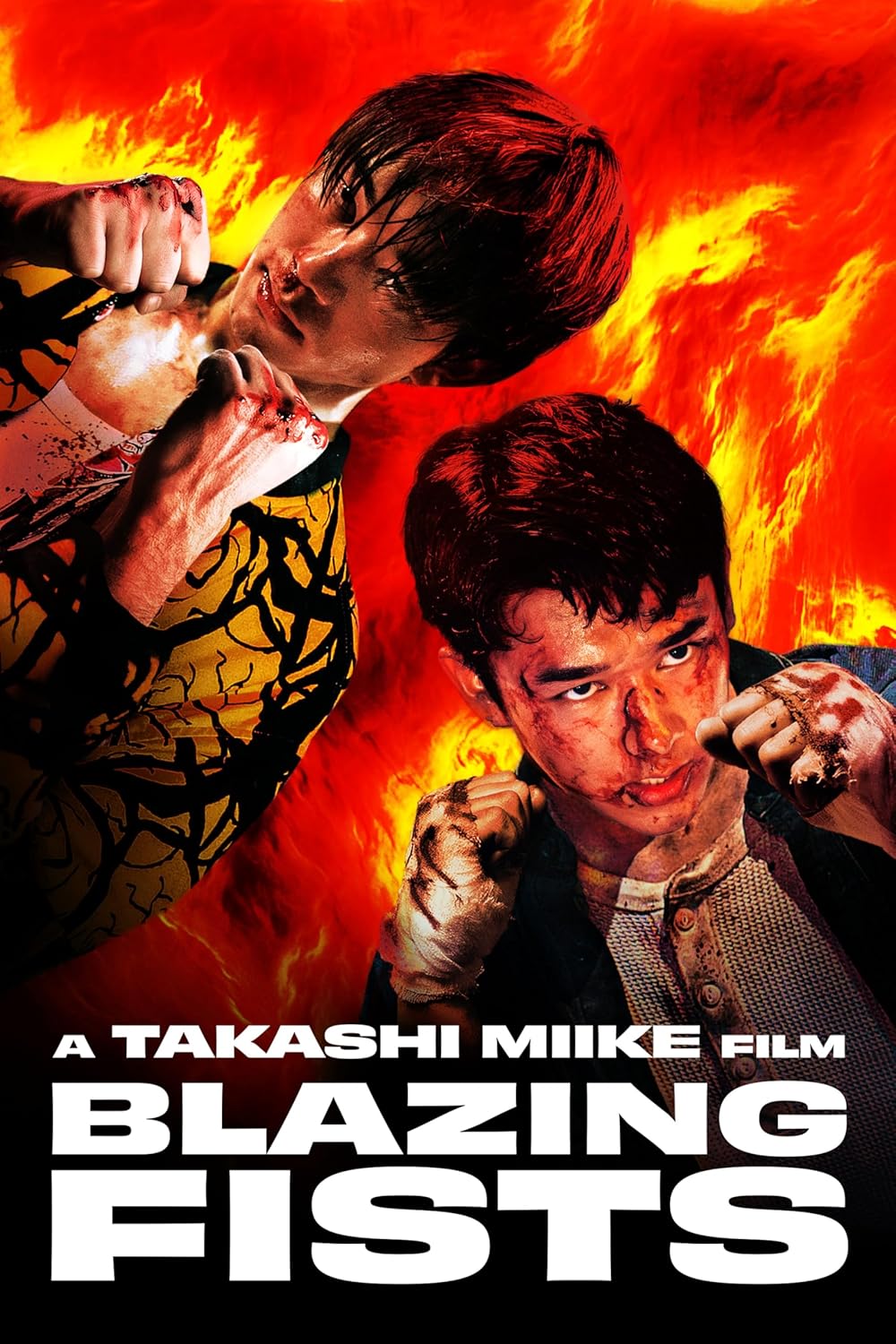
Blazing Fist | Blu-ray (Well Go USA)
Director: Miike Takashi
Cast: Kinoshita Danhi, Yoshizawa Kamame, Mikuru Asakura, Gackt, Kuon Chikashi, Mariko Shinoda, Katsunori Takahashi, Susumu Terajima, Riki Sanada
Running Time: 119 min.
By Paul Bramhall
Over the last year chances are that, if you spend enough time scrolling on social media, you’ll have come across clips of trash talking Japanese fighters yelling at each other and almost coming to blows, set in what appears to be some kind of underground tournament. The clips are likely from the YouTube series Breaking Down, an amateur kickboxing tournament founded by mixed martial artist Mikuru Asakuru, which invites everyone from streetfighters to fellow mixed martial artists to take part in short one-minute rounds (perfect for the social media age!). Asakura himself came from a street-fighting background, eventually finding his way as an MMA fighter, rising up to most famously take on Floyd Mayweather in 2022. In 2025, he decided to enter the film industry, producing (and appearing as himself) in Blazing Fists, which features his Breaking Down series as a prominent part of the plot.
I guess it’s a little like if The Scrapyard where to make a movie in the U.S.. While a production based around a YouTube fighting series may seems like a dubious proposition, Asakura has brought onboard Miike Takashi to sit in the director’s chair, a name guaranteed to grab the attention of any audience who enjoys the wilder side of Asian cinema. For long time fans of Takashi his frequently unhinged 1990’s V-Cinema output casts a long shadow over anything he’s done in the 21st century, with any time he helms an inherently mainstream production (the likes of Sham or Shield of Straw) usually met with criticism. I confess I’m sometimes part of the same demographic, the result of a filmmaker who seemed to make genre excess and a complete disregard for good taste his modus operandi for the longest time. However every filmmaker evolves, and not everything needs to be a Visitor Q or an Audition.
In Blazing Fists he tells the story of a pair of youths who meet in a juvenile detention centre, played by Kinoshita Danhi and Yoshizawa Kamame, here both making their big screen debuts. While Danhi is very much a fresh face, having only a couple of supporting roles in J-dramas to his name, Kamame has plentiful J-drama experience, in addition to being a member of the J-pop group GNJB. While in detention they attend a motivational speech by a visiting Mikuru Asakura (playing himself), and become inspired to train so they can make it through the Breaking Down selection process, leading to an actual streamed fight. Once released on probation though the wayward youths from their pre-juvie life start to circle, with the presence of a powerful cult like biker gang called Krishna, led by Japanese rocker Gackt (Bunraku, Moon Child), threatening to derail their plans and send them straight back into detention.
Making it onto a YouTube fight tournament may feel relatively low stakes to sustain a 2-hour movie, so there’s all manner of sub-plots introduced to sustain the momentum. Kamame actually has a secret that relates to why Danhi was sent to juvenile detention in the first place. Danhi’s father is accused of murder and awaiting trial, which has led to their relationship becoming estranged. Another wayward youth has become the leader of a gang of high school dropouts, and seems set on a path of self-destruction. To top it all off, once the Breaking Down tournament does become part of the plot, Danhi’s opponent turns out to be the sneering son of the prosecutor responsible for his father’s pending murder case. In short, it feels a bit like watching a Latino daytime telenova.
However, the genius of Blazing Fists is that Takashi seems to know it, and treats the absurdly pure intentioned plot with a mix of both sincerity and left of field humor. As a director Takashi has always treated the medium of film as a canvas to paint his more bizarre moments of inspiration – from characters pulling out bazooka’s out of nowhere in Dead or Alive, to bullet-time cock fights in The City of Lost Souls. While the wilder aesthetic side of his creative process may not be as out there as it was in the 90’s and early 00’s, Blazing Fists still has plenty of instances where his distinctive style of surrealist humor comes to the fore, it just feels more subtle than it was previously.
From a cast who are blatantly not high school age and the fact nothing is done to hide it, to Danhi and Kamame having parallel phone conversations with their mothers, to a character getting a dart lodged in his skull and continuing to converse like nothing happened. These oddball moments are all distinctly Miike Takashi in their style, inserting a level of absurdity into the plot but playing it completely poker faced, resulting in Blazing Fists having a number of laugh out loud moments that come out of the blue. Even when people are having their arm repeatedly snapped in the wrong direction though, Takashi keeps the pure heart of Blazing Fists untainted (and the character on the receiving end turns up completely fine a couple of scenes later), with there being an argument for it perhaps being the most feel-good movie of his whole filmography (an award I’d previously considered as belonging to Dead or Alive 2: Birds).
There’s a metaphor spoken throughout about how certain characters lives are hurtling towards the edge of a cliff, and if it’s possible for them to put on the brakes before it’s too late, giving even some of the characters who are introduced as villains (a debuting Kuon Chikashi is a highlight) a relatable angle. The result is one that can sometimes feel like we’re in an alternative universe to Takashi’s Crows Zero series, taking the same type of characters in the form of high school ruffians, and filtering them through the lens of a classic sports movie story arc. It shouldn’t work, yet somehow it does, with Danhi and Kamame making for a pair of protagonists who are easy to root for as the audience, and carry a level of screen presence that’ll hopefully be built upon in future productions. Takashi has always had an eye for up-and-coming talent, and the pairs performance certainly belies their lack of big screen exposure so far.
Surprisingly the Breaking Down tournament doesn’t take center stage for the finale, with one of the gang members who used to go to school with Danhi captured by the Krishna gang, leaving the pair left with a decision to make on the night they have an opportunity to have one of their fights streamed. Give it up and attempt to rescue one of their own, despite the differences they’ve faced throughout the runtime, or let him fend for himself and seek YouTube glory. It’s a non-spoiler to say they opt for the former, leading to an epic group fight scene as the pair take on a small army from the Krishna gang, while Gackt quietly observes the chaos in the way only a final boss tends to do.
If anything the finale made me wish we’d seen more of Gackt, as he conveys a suitably intimidating screen presence, and the mysterious aura his character comes with only adds to the intrigue. He also gets one of the best laugh out loud moments, with the final scene he appears in recalling a similar scenario from a certain Takeshi ‘Beat’ Kitano in 2000’s Battle Royale. While the fight scenes are evenly spread throughout Blazing Fists and mainly consisting of boxing, it’s worth noting that this is not the movie to clock in for purely for fight action by any means. The focus here is primarily on the story of growth and friendship between Danhi and Kamame, and to that end Takashi successfully captures the way their bond develops, proving that he remains a master of any genre he applies his talents to.
If someone were to tell me a few years from now that Miike Takashi once directed a movie based on a YouTube underground fight tournament that combined elements of telenova level melodrama, gangland turf battles, boxing, and surrealist humor, would I believe them? If it was anyone else, probably not, but this is Miike Takashi after all, and even in 2025 he continues to surprise. Blazing Fists proves to be a worthy addition to his filmography, and hopefully provides star making turns for Kinoshita Danhi and Yoshizawa Kamame.
Paul Bramhall’s Rating: 7/10