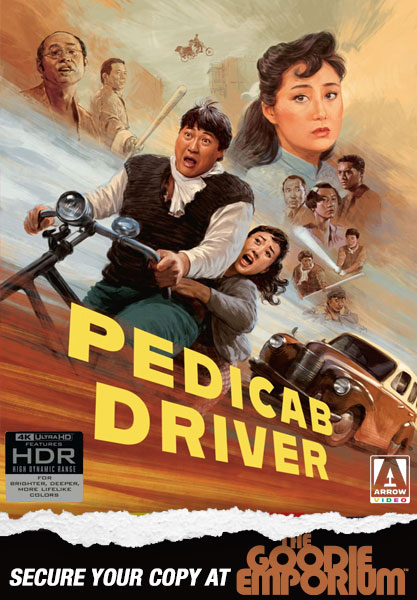

I’d forgotten, until Arrow announced the 4K of Pedicab Driver for December, that the best fight in that film happens in a gambling house. Sammo Hung’s pedicab chase crashes into a Macau casino, Ping’s money goes everywhere, and what you get instead of an apology is Sammo and Lau Kar-leung going at each other with poles across the tables while the games carry on being ruined around them. The setting does half the work, because there’s cash on the table and a boss who makes his own law, and a disagreement in a room like that can only go one way.
Most of us know casinos from the other side of the velvet rope, or from a hand of online blackjack on the sofa, which is about as far from Lau Kar-leung’s gambling house as you can get while still calling it the same business. Hong Kong cinema never had much use for blackjack. A hand of it is two people and a shoe, and the genre wanted a crowd: dice, mahjong, baccarat and five-card stud, games with a table full of faces and somebody’s fingers to watch.
The casino keeps turning up in action cinema because it gives the villain a legitimate front and men on the door, puts a lot of money in one room so the stakes need no explanation, and has private rooms behind the public one, so the hero walks in through the front and gets dragged out the back. Rush Hour 2 is the Hollywood version: Steven Reign’s brand new Red Dragon launders a hundred million in counterfeit superdollars that Ricky Tan supplies, Chris Tucker holds up the craps table with a monologue, and Jackie Chan ends the night kicking Tan out of the penthouse window. New Line built the Red Dragon’s front onto the closed Desert Inn, dragon and all, and the hotel’s first tower was rubble by Christmas 2001.
Hong Kong got there first and went harder, because its gambling films and its triad films were made by the same people. A Hong Kong Film Archive programme note reads the gambling films as “metaphors for capitalism” and dates their peak to the late 1980s. Casino Raiders, from 1989, is the one I’d point a newcomer at: Andy Lau and Alan Tam as professional gamblers brought in to expose a Japanese crew cheating a Lake Tahoe casino, a triad ambush that costs Lau the use of his left hand, and a climax at the poker table where the Japanese heavy wagers an arm and a leg, literally, against Idy Chan playing for the wounded Tam. Wong Jing co-directed with Jimmy Heung, and he has been remaking that table ever since.
The underground version is a different film. Ong-Bak’s fight club is a bar off Khao San Road where the bets are made in cash and the fighters are the entertainment; Tony Jaa’s Ting only steps in because his money has been stolen and wagered by somebody else, and the bout is over in a kick. The gambling there is on the fighting itself, which turns the casino film inside out: the brawl doesn’t interrupt the game, it is the game, and the crowd has money on it.
What the games bring is rhythm. A dice cup hitting a table gives an editor a beat, and a hand of mahjong is a conversation with tiles, which is why Hong Kong directors preferred them to anything played quietly against the house. Blackjack, on the rare occasions it appears, is a Western import and a brief one.
The games have outlived the rooms. The Desert Inn is gone, Macau has rebuilt itself more than once since Pedicab Driver, and the dice and the cards moved onto phones along with everything else. What the films understood, and what I’d forgotten until the Arrow announcement, is that the game was never the draw. It was who else was at the table, and whether they’d let you leave.