


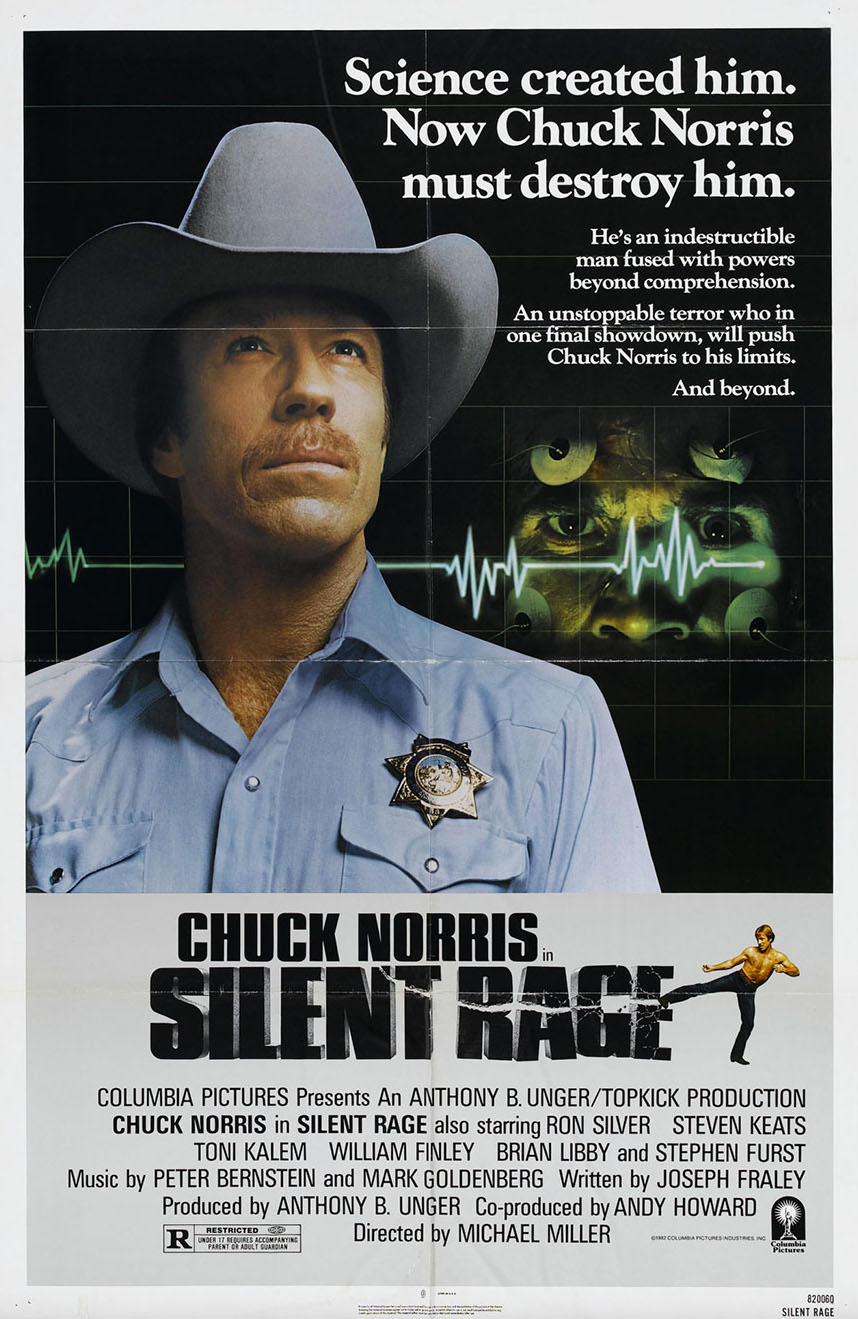
“Silent Rage” Theatrical Poster
Director: Michael Miller
Cast: Chuck Norris, Ron Silver, Steven Keats, Toni Kalem, William Finley, Brian Libby, Stephen Furst, Joyce Ingle, Jay De Plano, Lillette Zoe Raley, Mike Johnson
Running Time: 100 min.
By Z Ravas
Can I just say that I love the idea that someone went to see John Carpenter’s Halloween in 1978 and said, “That was great, the only thing it was missing was Chuck Norris!”
Yes, I’ve long held an outsized affection for Silent Rage precisely because of how unique its premise remains, not only in Chuck Norris’ filmography but in the context of 1980’s action movies: in form and function, it closely resembles one of the myriad of Halloween sequels, with a superhuman killer stalking his victims in a small town—only with the added bonus that martial artist extraordinaire Chuck Norris is here to eventually take the killer down!
It helps that Brian Libby is extremely well cast as the villain, a fact that’s established from the first scene which quotes liberally from the tracking shot that opens Carpenter’s Halloween as well as Jack Nicholson’s famous poke-his-head-through-the-door moment from The Shining. (Hey, sometimes the way to let your viewer know that they’re in a horror movie is…by riffing on other horror movies). At 6’4″, Libby towers over Chuck Norris, and his sweaty, almost simian-like performance sells you on the idea that something is not quite right with this guy.
Silent Rage does face one conceptual problem, however: if the script pits Chuck against our killer too soon in the film’s runtime, we know that only one of them is going to walk away from the encounter, so the movie—which probably should have been a tight 90 minutes—has to find ways to put off their confrontation. Which means Brian Libby spends a lot of the film strapped down to a gurney, generally being experimented on, and we get sidetracked by a ridiculous love subplot involving Chuck Norris and Toni Kalem (who I sense is a better actress than this material really deserves). I’ve noticed that a lot of Chuck Norris movies go out of their way to feature Chuck navigating a romantic relationship, you wonder if it was Chuck’s request or if filmmakers simply thought audiences would want to see ‘the softer side of Chuck Norris.’
The gentle lovemaking is more than a little misguided, however, since we’re obviously here to watch Chuck spin kick the bad guys into oblivion. Fortunately, Silent Rage tosses in a bar fight to keep the audience entertained during its midpoint—and it might just be the best bar fight of Chuck Norris’ career. It’s an absolute blast to watch him tear through an entire bar’s worth of rowdy, drunken bikers like they’re nothing but sheet paper. There’s one part where the hyper-fast editing manages to suggest that Chuck kicks a thug in the face about four or five times in a row, a good example of how fast cutting can actually improve the impact of a fight sequence if deployed well. No doubt Hollywood in 1982 was still far behind what Hong Kong action cinema was accomplishing at this time, but Silent Rage holds its own thanks to Chuck’s swagger and the stunt crew’s willingness to be tossed around the bar like rag dolls.
I first saw Silent Rage as a teenager; I remember being quite effusive about it afterwards, and the sheer novelty of Chuck Norris starring in a movie you could accurately call a horror or slasher flick has stayed with me all these years. I was keen to revisit Silent Rage in the wake of the legendary martial artist’s recent passing at the age of eighty-six. Seeing the film with the sober eyes of adulthood, I have to acknowledge it’s not some lost classic of the Eighties—it’s a superior Chuck Norris movie, no doubt about that, but it’s not something that I would recommend to anyone who isn’t already a fan of Chuck. For one thing, the tone here is a bit all over the place: the synthesizer-driven soundtrack really nails the horror vibe, but then you’ll get a scene of Chuck and his co-star cuddling in a hammock set to a syrupy love ballad—or a supposed comic relief moment with Chuck’s goofy deputy, who feels like an extra from a John Landis comedy.
But I know I’m not the only Chuck fan out there who will appreciate this one. Given all the criticism Norris took for his sometimes wooden acting (and you can tell how much Silent Rage director Michael Miller leans on Timecop actor Ron Silver to carry this film’s more dramatic moments), Chuck’s appeal can sometimes be difficult to articulate. Nevertheless, you have to pay the man his respects: even before he entered his Cannon Films heyday, Chuck was there in the late Seventies and early Eighties, holding down the Western front as one of Hollywood’s only martial arts-trained action stars. Silent Rage took a risk by asking, ‘Wouldn’t it be cool to see Chuck Norris fight Michael Myers?’ Over forty years later, you have to admit it is indeed pretty damn cool.
Z Ravas’ Rating: 7.5/10





My favorite Chuck film next to Return of the Dragon! When he passed, I watched both movies that weekend. He will be missed.