
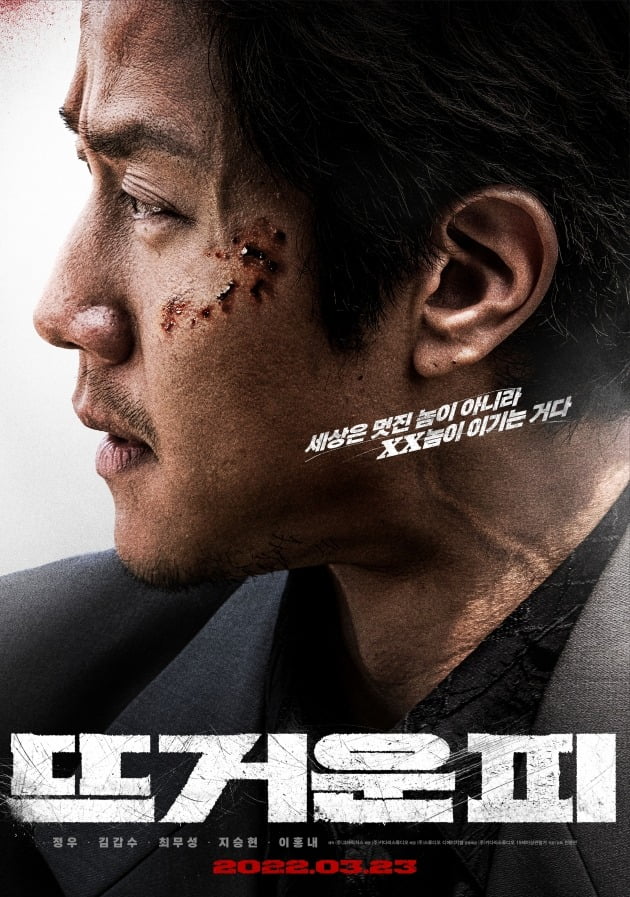
“Hot Blooded” Poster
Director: Cheon Myeong-Kwan
Cast: Jung Woo, Kim Kap-Soo, Choi Moo-Sung, Ji Seung-Hyun, Lee Hong-Nae, Yoon Ji-Hye, Lee Sung-Woo, Yoon Dae-Yul, Hyun Bong-Sik, Heo Dong-Won
Running Time: 120 min.
By Paul Bramhall
In the opening scene of Hot Blooded we follow a gangster played by Jung Woo (Dirty Money, Spare) as he’s dropped off on a boat in the open sea. Sat around a table are his fellow criminal brethren, and as they exchange the obligatory small talk and pleasantries, one of the gangsters offers him a gift wrapped in a plastic bag. Clearly a gun, the others around the table react with a mix of surprise and confusion, questioning why Woo would need a firearm. It appears his plan is to kill someone who’s present at the same table, but before he can pull the trigger, the scene cuts, the narrative going back in time so we can understand the events that have led to the fateful meeting.
It’s a classic narrative hook to kick off proceedings with a final scene cliffhanger, serving the dual purpose of offering up an attention-grabbing setup from the get-go, while building audience curiosity to know what went down to get to such a point in the first place. The biggest issue with Hot Blooded, is that it feels like a lifetime passes before we eventually re-join Woo on the boat, and once you understand that the source material is a 600 page sprawling novel by author Kim Un-su (titled Hot Blood, which is what the Korean title directly translates to), it becomes clear as to why.
Marking the directorial debut of Cheon Myeong-gwan, while a look at his filmography may seem sparse, there’s actually a good reason for that – he’s primarily a novelist. In fact just as he’s adapting a novel for the screen with his debut, so one of his own novels has also been adapted for the screen, when his 2010 novel Aging Family was turned into a movie by director Song Hae-seong in the form of 2013’s Boomerang Family. Off topic, but he also wrote a novel titled My Uncle, Bruce Lee, told from the perspective of the title characters nephew about his Bruce Lee obsessed uncle. Now that I’d like to see adapted into a movie, although obviously the Bruce Lee Estate could present a challenge.
Myeong-gwan’s literary leanings are perhaps also his Achilles heel when it comes to adapting written works into a cinematic format, as the insistence to seemingly include every character that pops up in the novel gradually comes at the cost of any kind of narrative thrust completely dissipating. Instead, character relationships end up being communicated by dialogue rather than any meaningful onscreen development, leading to a disconnect in many of the relationships we’re supposed to be invested in. Ji Seung-hyun (The Swordsman, Svaha: The Sixth Finger) plays a gangster working for a rival faction that grew up in an orphanage together with Woo, however their shared background never feels meaningful. Yoon Ji-hye (Asura: The City of Madness, Whispering Corridors) plays a former bargirl who’s apparently in a relationship with Woo, although this plot point only becomes clear once they decide to move in together.
Characters flit in and out of the narrative that serve little purpose, and the result is one that makes it difficult to ascertain exactly what it is that’s at stake. Myeong-gwan’s in luck mainly due to Woo’s portrayal of a 40-year-old gangster who’s become tired with his lot, realising that if he’s going to make something with his life it’s now or never. During the first hour the loyalty to his boss, played by Kim Kap-soo (Steel Rain, A Tale of Two Sisters), is frequently tested by rival associates, the main one being a loose cannon played by Choi Moo-sung (A Special Lady, I Saw the Devil). It’s the latter who Woo ultimately chooses to set up, arranging a beatdown between gangs in which he steals a bag of drugs from the laundromat under Moo-sung’s control, then ensuring there’s enough evidence left over for the police to send Moo-sung away for long enough that he’ll no longer be a threat.
It’s tried and tested gangster movie territory, but Myeong-gwan handles it well, complimented by the shabby 1993 Busan setting that offers up a breath of fresh air compared to more contemporary outings. It’s also this event though which begins to highlight the disadvantages of trying to cram so much story into just 2 hours, as Woo’s sudden ascension through the ranks, basically told through what amounts to a montage, fails to feel like a natural progression, instead coming across as rushed. Suddenly he’s moving in with Ji-hye and becoming a stepfather to her just out of prison son, played by Lee Hong-nae (Spiritwalker, The Divine Move 2: The Wrathful). The relationship between Woo and Hong-nae in particular feels like it should have been left on the cutting room floor since, while I’m sure it added a level of characterisation in the novel, onscreen it only feels like yet another character being thrown into the mix.
It’s unfortunate, as Hong-nae offers up a spirited performance, and his role feels much more critical to the plot than his screentime alludes to. There’s a seed of a story about how one generation is trying to do good by helping the next generation in there somewhere, but again there’s so much noise surrounding their relationship that anything beyond the surface level is lost in the mix. Instead, the last third of Hot Blooded descends into a series of back stabbings, betrayals, double and triple crosses, and characters surviving a ridiculous amount of bodily harm, so much so that the audience can be forgiven for becoming numb. There were at least 3 times when I honestly thought it had finished, and was expecting the credits to roll, only for the story to keep on going, and going, and going. When it finally got back around to the original scene with Woo arriving on the boat, I confess to having forgotten that that’s what I should have been waiting for.
While multiple betrayals are common in the gangster genre, the issue is that they happen between characters that are nowhere near developed enough to care about. At least we should feel something when a character is killed off – whether that be sadness or a sense of catharsis – but here that’s missing. We get a protracted death scene in the entrance to a karaoke bar that should carry an emotional punch, but instead all I was thinking was for them to hurry up so proceedings could wrap up. It’s worth noting that while Hot Blooded does have its moments of violence, it’s by no means a bloodbath compared to some of its contemporaries. A gangster movie crafted with a focus on dialogue over relying on scenes of violence should be applauded , but to go that route there needs to be a strong grasp on story and characters to keep the audience engaged (The Shameless being a perfect example).
Hot Blooded just doesn’t have that, and it’s ultimately detrimental to how enjoyable it is, neither being a particularly strong character study in what it means to be a gangster, nor delivering enough on the action front to at least offer up a slice of gangster genre comfort food. Having said that, while I can’t confirm if it’s exactly what happened in the novel, there is one scene in which a character is tortured by being made to eat sea urchins. Not the type that’s already been prepared as sashimi – the type that’s fresh from the sea and still have their long spike covered black shell – and I confess that I may have winced once or twice as the scene played out. As somewhat of a Korean gangster movie veteran, I have to admire any movie made in the 2020’s that still manages to find an original way to inflict grievous bodily harm.
Overall though Hot Blooded is simply too overcrowded, resulting in a story that frequently feels muddled and lacking any kind of meaningful objective (even one of my favorite Korean actors, Yoon Je-moon, turns up and ends up criminally wasted). These mid-budget Korean gangster movies were cranked out at pace in the early 2020’s, and ironically 2021’s Paid in Blood suffered many of the same issues, so perhaps it’s symptomatic of where the genre was at. My biggest surprise is that there’s actually a director’s cut out there, titled Hot Blooded: The Original, which I can only assume extends the runtime even further. As for me, at one point the big gang boss states “I don’t have a way with words, so I’ll keep it short.” I only wish Myeong-gwan had done the same.
Paul Bramhall’s Rating: 5/10